This Christ-centered blog is designed to serve stroke survivors, families and friends, through sharing experience and faith. My own stroke came on May 8, 1998. God provided medical professionals, friends, fellow believers, and strength to get me through some struggling recovery times.
[B]ut those who hope in the LORD will renew their strength. They will soar on wings like eagles; they will run and not grow weary, they will walk and not be faint.
You've seen these words before in this blog. But I can't resist for a repeater for this one.
Not long ago, due to months of recovering from a non-stroke-related back injury, I ran slowly and, sometimes, with a little pain.
Just last month, I finished the first half-marathon (13.1 miles) that I've run in more than a year.
So to celebrate the real reason why I accomplished this, why not repeat these words? God did renew my strength. I did complete - albeit slowly - and was able to enjoy the rest of the day with family. Not weary. Not faint.
Interesting article was caught in my Google alert about the increasing number of different therapy techniques notes, wisely, that each stroke patient is unique and needs a special approach for best outcome. The article, in McKnight's Long Term Care News, focused on long-term care patients, but the same is true for us all:
Determining the best therapy approach isn't easy because each stroke incident, degree of impairment, rate of recovery and overall outcome is as unique as the residents themselves. Treatment approaches, too, are anything but one-size-fits-all. The good news is an ever-growing array of stroke-recovery therapies and supplemental — and, in some cases, experimental — practices are allowing therapists to add some new and promising treatment approaches to their arsenal.
“We know that the brain has a remarkable ability to regain lost function, and we also know that the route each person can take toward recovery can be very different. What works for one person might not provide the same result in another, and the goals and priorities will also differ from one person to the next, which is why therapy must be tailored to each individual,” says Jan Davis, MS, OTR/L, president and founder of International Clinical Educators Inc. She's also the spokeswoman for the American Occupational Therapy Association on issues related to stroke rehabilitation.
We all know that smoking is unhealthy and is a known contributor to stroke risk.
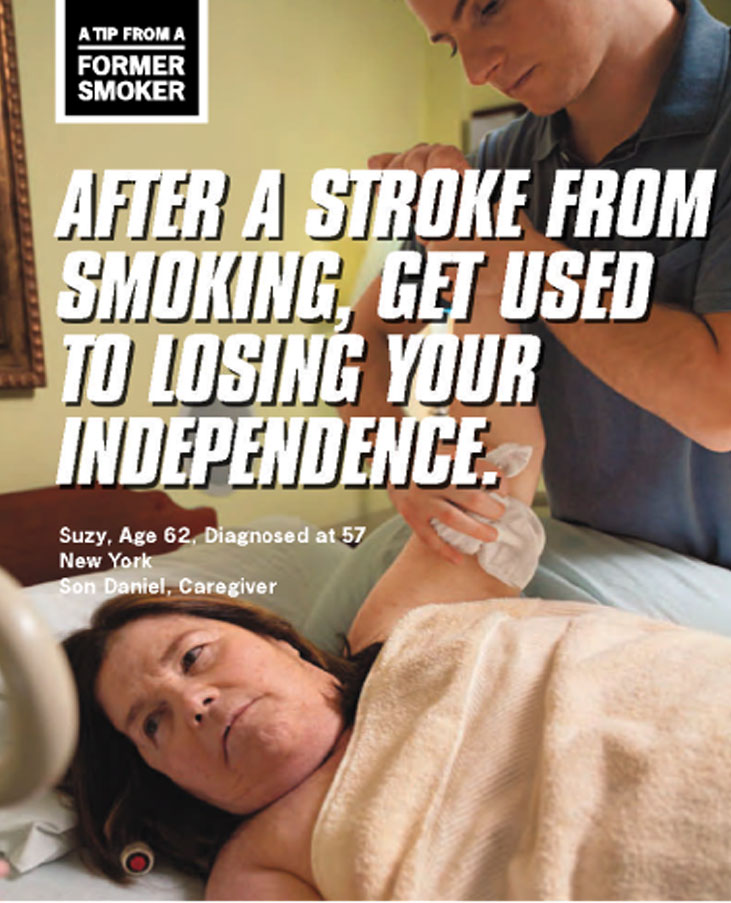
The Centers for Disease Control and Prevention recently launched an effort to reduce smoking, including the poignant image of a woman who is a former smoker and stroke survivor with profound physical problems.
People who smoke menthol cigarettes were more likely to have a history of stroke than smokers who prefer regular cigarettes, an analysis of federal health survey data indicated.
"These results highlight the need for further review of the last legally allowed tobacco additive in North America, given that mentholated cigarettes may be placing individuals at even greater risk of potentially devastating cerebrovascular disease than regular cigarettes," Vozoris wrote.
We've all experienced it - anxiety. Work. Marriage. Health. Children. Parents. The list goes on and on.
Stroke patients, too, can become consumed with anxiety. It's often uncertain exactly what the future will bring. Each human brain is unique, and therefore an individual's response to treatment, therapy and surgery is not guaranteed.
That being said, we have a place where we can place our anxiety, our fears and our worries. Take your issues to the one who has seen it all and can help remove your anxiety and fill you with hope.
Accept his love and hope. He will see you through.
More Lazarus-related news - Australian researchers have seen promising results using a second clot-busting drug vs. the now-standard Alteplase, also called tissue plasminogen activator or tPA..
Associate Professor [Mark] Parsons said there was often a "Lazarus-like" effect among the Tenecteplase patients as they appeared to rise up off the bed. Lazarus, in the Bible, was raised from the dead.
"The results were quite dramatic and a bit surprising for us in that in the new drug Tenecteplase, more than two-thirds of patients had this dramatic response within 24 hours where they almost fully recovered," Associate Professor Parsons said.
"With the standard drug it's about a third."
I've always enjoyed the Lazarus reference - including my own Lazarus-effect moment in 1998. With more research, here's to more Lazarus experiences for stroke patients.
Just a couple of postings ago, this blog noted that research showed that there is still often a time issue for stroke patients - they are too often not getting to help in time.
Nationwide, only about half of stroke patients arrived at the emergency department via ambulance and that figure hasn't changed over a 10-year period, Hooman Kamel, MD, of Weill Cornell Medical College in New York City, and colleagues found.
"Our findings suggest that national efforts to address barriers to ambulance use among patients with stroke need to be intensified or adjusted," they reported in a research letter in the March 14 issue of the Journal of the American Medical Association.
Thrombolytic therapy improves outcomes after ischemic stroke, but most patients don't present to the hospital in time, which is typically within 4.5 hours of symptom onset. That's despite numerous educational efforts to encourage people to call 911 at the earliest signs of stroke, especially because being transported via ambulance results in quicker arrival at the emergency department."
Thank God - and I mean thank God - someone had the presence of mind to summon an ambulance on the day my stroke occurred. But too often, that doesn't happen.
Now, does calling for ambulance guarantee an ideal outcome? No. Nothing can. But does failing to call 911 reduce your chances of a good outcome? Absolutely.
(Image from Alexander County (N.C.) Health Department)
The wall between the two chambers was not a nice straight, smooth surface, but was more wavy with a divot, also called an atrial septal aneurysm.
Normally, blood pumps into the vein side of the heart, then out the lungs to get oxygen and get filtered for clots and debris, the back into the arterial side and eventually out to the brain and body,
However, clots and debris could collect in the divot and with a little extra chest pressure - even a sneeze - could push that from vein side to arterial side, bypassing the filtering process.
I think, though, one important takeaway from this research came from an ABC News quote:
Dr. Anthony Furlan, the study's lead author and chairman of neurology at University Hospitals Case Medical Center in Cleveland, said the evidence just isn't there to support a PFO closure procedure over simply giving patients medication.
"We're not saying there are no patients who should have the hole closed, but we are saying the selection criteria have to be radically refined," he said. Ideally, a patient would be under age 45, have a very large hole in their heart and a heart defect called an atrial septal aneurysm.
When my stroke occurred, I was a "young" 39. Plus, the atrial septal aneurysm was - now much more solid thanks to the device implanted - present.
Did I really want to be on a sometimes-dangerous blood thinner for the rest of my life? No. For me, I think the closure was the best choice. Is it for everyone? The real answer, like many medical answers, is not so clear. Each individual's circumstances should be considered.
The CDC researchers found that almost 44 percent of patients who had strokes between 2005 and 2010 took more than 4.5 hours to get to the emergency room after their first symptoms.
That's up from the almost 40 percent who hesitated before going to the hospital in 2005. At the same time, the percentage of stroke victims who got to the hospital within two hours also decreased — from 40 percent in 2005 to 35 percent in 2010 — another sign that people may not understand the need to get prompt medical care.
About 795,000 Americans suffer a stroke each year, according to the CDC. The most common type (87 percent of all strokes) is ischemic stroke, caused by a blockage in the blood flow to the brain.
You must get to help. Is that a guarantee? No. But it certainly increases your chance of positive outcome.
A recent story about stroke research indicated that mice kept in solitary generally do worse than mice with partners. Now, mice aren't people. But I can tell you in my own experience that friends, fellow believers and family made a huge difference in my own recovery.
Mice that were socially isolated tended to have greater ischemic infarct volumes relative to mice paired with a stroke partner or a healthy partner. In addition, the solitary mice had significantly decreased levels of brain-derived neurotrophic factor (BDNF), a protein that helps support the survival of existing neurons.
(Generic mouse photo from the National Institutes of Health)
Women with the highest levels of flavanone in their diet were 19% less likely to have an ischemic stroke during 14 years of follow-up than those with the least flavanone intake (P=0.04), Aedín Cassidy, Ph.D., of the University of East Anglia in Norwich, England, and colleagues found. ...
Most of the flavanones consumed by women in the study came from orange and grapefruit juice (63%). But eating the whole fruit would likely be a better way to boost intake, the researchers suggested.
"Given the higher flavanone content of citrus fruits and the sugar content of commercial fruit juices, public health recommendations should focus on increasing citrus fruit intake," they recommended in the paper.
Unless you've got a health reason not to eat an orange a day, this isn't a bad idea at all. This research doesn't prove the link, however.
(Photo from U.S. Department of Agriculture)