Showing posts with label centers for disease control and prevention. Show all posts

Tuesday, January 19, 2016

Why watch the salt? Read the latest facts

How much salt do you need? Probably less than you consume.

If you are a typical American consumer, chances are 9 out of 10 that you consume too much sodium. The problem? It can contribute to high blood pressure, which is the leading cause of strokes.

This has been in the news before, of course, but habits are hard to break. Read more how Americans still consume too much salt:
More than 90 percent of children and 89 percent of adults consume more sodium than is recommended in the new 2015-2020 Dietary Guidelines for Americans, according to the U.S. Centers for Disease Control and Prevention. The new guidelines advise no more than 2,300 milligrams (mg) of salt a day -- about a teaspoon -- for most adults.

Tuesday, January 06, 2015

Stroke falls in U.S. causes of death

In the news, you can find a New Year hint that stroke treatment seems to be working. Recently, the U.S. Centers for Disease Control and Prevention reported that stroke is dropping down the list of cause of death in the United States.

Read through this link how stroke falls one place to fifth leading cause of death in U.S.:
Commenting on the Centers for Disease Control and Prevention (CDC) report, the American Heart Association (AHA) hypothesize that the drop in deaths from stroke is due to advances in the treatment and prevention of stroke. In particular, the AHA note, there are more stroke centers now operating across the US, and there has also been an improvement in acute care of stroke.

Tuesday, September 10, 2013

CDC: Thousands of strokes are preventable

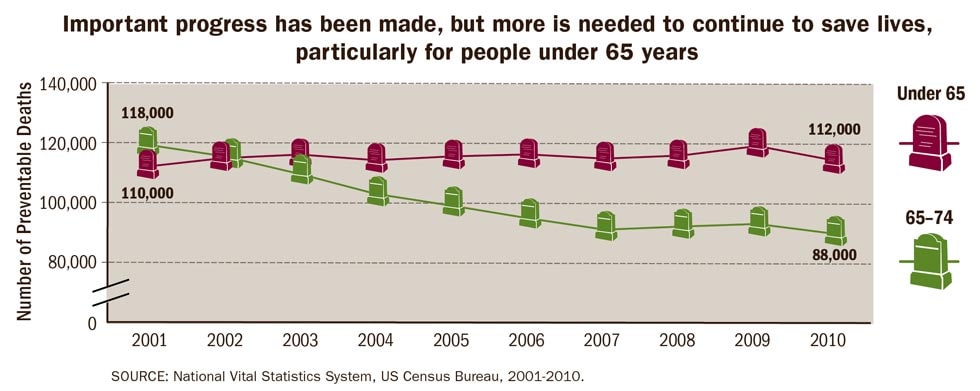
Many strokes - especially striking the "younger" set - are preventable. The U.S. Centers for Disease Control and Prevention recently released new figures about those deaths.

You might have read about stroke risk factors here before - especially smoking and high blood pressure. Controlling those factors can add years of healthy living to many lives. Read the article about how 200,000 heart disease, stroke deaths could be prevented:
"As a doctor, I find it heartbreaking to know that the vast majority of people who are having a heart attack or stroke, under the age of 65 in particular, and dying from it didn't have to have that happen," CDC director Dr. Tom Frieden said during a noon press conference. ...
Each year in the United States nearly 800,000 people die from heart disease or stroke, many of which could have been prevented by proper medical management and lifestyle changes to control risk factors, Frieden said.
Click here to read a summary from the CDC.


Tuesday, August 14, 2012

Awesome treatment: Walking

Walking is one of the best "medicines" anyone can take. It can be habit-forming - for the good. Walking - and other exercise - can help prevent strokes and a myriad of other health problems.

Not long ago, the U.S. Centers for Disease Control and Prevention released some survey information about walking activities. More people are walking, but not yet enough, says a MedPage Today article:
Still, walking is a "wonder drug" that can prevent a variety of maladies from diabetes to cancer, CDC director Tom Frieden, MD, MPH, said during a phone call with reporters.
"I would say there's no single drug that can do anything like what regular physical activity does," Frieden said.
The data come from the CDC's 2005 and 2010 National Health Interview Surveys, and Frieden said the increase in walking prevalence was seen across almost all demographic groups.
Yet only 48% of Americans are meeting 2008 guidelines that recommend at least 150 minutes of moderate-intensity aerobic exercise, such as brisk walking, per week, and a third of Americans said they don't get any physical activity at all.
(Photo from CDC) 

Thursday, July 12, 2012

Stroke info research tool

How does your county stack up in stroke statistics - how many and their outcomes, plus details of income, race, age and more, and how those factors might influence those numbers.

The U.S. Centers for Disease Control and Prevention just launched an interactive atlas of heart disease and stroke:
CDC's Division for Heart Disease and Stroke Prevention has created the Interactive Atlas of Heart Disease and Stroke, a new online mapping tool that documents geographic disparities in the burden of cardiovascular disease (CVD) at state and county levels. Users can create county-level maps of nine different CVD outcomes, by sex, race/ethnicity, and age group, and can overlay maps with congressional boundaries and locations of health-care facilities. Users also can view maps showing county-level social determinants of health and health services, including poverty, education, and food acquisition determinants.

The Interactive Atlas of Heart Disease and Stroke is available at http://apps.nccd.cdc.gov/dhdspatlas.

Wednesday, May 04, 2011

CDC resource for stroke awareness

The Centers Disease Control and Prevention just updated and posted some stroke-related materials for Stroke Awareness Month.

It includes statistics, stroke signs and symptoms, and more. Follow this link for some good resources:
Although most strokes occur in people aged 65 years or older, strokes can occur at any age. For example, a new CDC study, Trends of Acute Ischemic Stroke Hospitalizations in the U.S.: 1994–2007, found that stroke hospitalizations increased among both males and females aged 5–44 years old, raising concern about this young population.

Knowing the symptoms of stroke and calling 9-1-1 immediately if someone appears to be having a stroke are crucial steps in getting prompt emergency medical care for a stroke.  New treatments are available that can reduce the damage caused by a stroke for some victims, but these treatments need to be given soon after the symptoms start.
 (Photo from CDC)

Monday, February 14, 2011

Strokes hit young people in rising numbers

A repeated message from this blog is that strokes can hit both young and old. While the stereotypical stroke patient is an elderly man, every group faces that risk.

It was especially brought home by recent research from the U.S. Centers for Disease Control and Prevention showing that ischemic strokes increased among teens and children:
"We cannot link anything in particular to the trend in younger patients, but I believe the role of obesity and hypertension will prompt a big discussion. Unfortunately, right now we can't speculate on the causes," said [Xin] Tong, a health statistician with the CDC's Division for Heart Disease and Stroke Prevention in Atlanta.

However, hospitals and physicians should be aware of the rising risk of stroke in young people, and the necessity to educate them about stroke symptoms, Tong said.

"Acute ischemic stroke is currently considered something that mostly happens to older people, but awareness of rising rates in the young is important or else tPA [tissue plasminogen activator] and other important stroke treatment may be unnecessarily delayed in younger patients," she said.
 For any age, everyone should take the stroke signs seriously and get help right away.

Thursday, October 07, 2010

World Stroke Day: Oct. 29

Oct. 29 is World Stroke Day - marking attention for the third leading cause of death in the United States.

The numbers are sobering. In the U.S., more than 795,000 strokes occur each year, according to the Centers for Disease Control and Prevention. The cost in dollars: $73 million. The cost of death and disability is uncountable. It is the leading cause of permanent disability in the United States.  Every six seconds, someone in the world dies from a stroke.

But it's not just numbers. World Stroke Day campaign also highlights the fact that stroke can be prevented and that stroke survivors can recover and regain their quality of life with care and support: To quote the CDC:
The campaign is asking people to commit to six ways to reduce their likelihood of having a stroke.

1. Know one's personal risk factors, including diagnosed high blood pressure, diabetes, or high cholesterol.
2. Be physically active and exercise regularly.
3. Avoid obesity by eating a healthy diet with lots of fresh fruits and vegetables.
4. Limit alcohol consumption.
5. Avoid cigarette smoke. People who smoke should seek help to stop now.
6. Learn to recognize the warning signs of a stroke and call 9-1-1 right away if someone is suspected of having a stroke.
The links on this list will lead you to other resources and previous postings. Preventing a stroke can prevent the loss of a life or a life of disability.

Tuesday, July 06, 2010

Read the labels - lower your stroke risk

Most Americans get too much salt - healthfinder.gov
... {S]alt is so pervasive in the food supply it's difficult for most people to consume less. Too much salt can increase your blood pressure, which is major risk factor for heart disease and stroke.

"Nine in 10 American adults consume more salt than is recommended," said report co-author Dr. Elena V. Kuklina, an epidemiologist in the Division of Heart Disease and Stroke Prevention at the U.S. Centers for Diseases Control and Prevention.

Kuklina noted that most of the salt Americans consume comes from processed foods, not from the salt shaker on the table. You can control the salt in the shaker, but not the sodium added to processed foods, she said.

Monday, May 19, 2008

Another Stroke Awareness Month resource

One more resource for Stroke Awareness Month, this one from the Centers for Disease Control and Prevention.

It's a Web page dedicated to the month with several resources and links of helpful material.