Showing posts with label walking. Show all posts

Tuesday, March 01, 2016

Stroke survivor, ever stumble - either via feet or speech? That's not a crime

Stroke survivors are often misunderstood. And while I can't condone smoking, I can feel for the stroke survivor claims she was wrongly jailed for public intoxication:
Deana said she had just left a convenience store, where she purchased some beer and cigarettes and was headed back to her apartment.
For much of her walk home, Deana said she tried to remain on the sidewalk. But it starts and stops, and because she can’t balance on the grass, she said she was forced to step out into the bike lane.

Tuesday, February 10, 2015

New blog widget, good exercise tips

Today, a little something different.

When I began running in earnest in 1987, I had no idea what I was doing. Then, a few years later, I received a gift: the first edition of "Galloway's Book on Running."

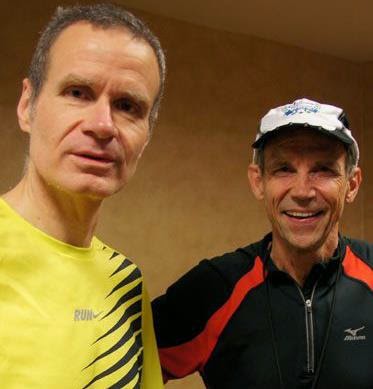
And I'm still running. On the way, I've bought Jeff Galloway's second edition book, another one of his book titled "Running Until You're 100," a run/walk/run timer from his website and actually met Jeff in 2012. (Thus this photo; he's the one on the right.)

I give him a lot of the credit that, despite a stroke, back problems and a knee injury, I ran today.

So I'm pleased to announce a new self-created widget for this blog - a series of training and motivation tips from Olympian Jeff. You can find it along the right side of this page. Every time the page loads, the widget generates a random tip from Jeff's list.

He's coached over a million runners - slow, fast and in between - to their goals through clinics, retreats, training programs, books and e-coaching. You can sign up for his free newsletter at www.JeffGalloway.com.

Now, what if you're not a runner? And I realize most people aren't. You can still benefit. Even if you walk - even slowly - you can use many of Jeff's tips from the new widget and from his books or website. I hope the new feature is helpful - as helpful I have always found his solid advice to be.

Thursday, February 27, 2014

Walking - yes, it can lower stroke risk

Photo from U.S. Centers for Disease Control and Prevention
As you might know, I'm a believer in exercise.

Here's the latest research that shows moderate exercise cuts stroke risk as much as strenuous activity:
The women who reported engaging in moderate physical activity in the 3 years before enrollment in the study were 20% less likely to suffer a stroke, compared with women who reported no activity.
Prof. Wang says she was surprised that the link to reduced stroke risk was strongest with moderate physical activity.
More strenuous activity such as running didn't further reduce women's stroke risk," she adds. "Moderate activity, such as brisk walking appeared to be ideal in this scenario."

Thursday, January 23, 2014

Walkable neighborhoods: Better health

It's well-established that walking is good for you. If you seen this blog before, chances are you've seen several blog postings about walking and other exercises as stroke prevention tools.

Sadly, not everyone have good access to places for walking. And that is not good for public health. More people walking means more people in better health. Here's a recent article about how walkable neighborhoods mean less obesity and diabetes:
Photo from U.S. Centers for
Disease Control and Prevention
Results from the research, which also sought to determine the best measures of "walkability" for public policy purposes, were published online January 14 in PLOS One by Richard H. Glazier, MD, from St. Michael's Hospital, Toronto, Ontario, and colleagues.
"While interventions to prevent obesity and promote healthy body weight are most often aimed at individuals, there is a growing recognition of upstream environmental factors, including the urban built environment, as potential targets for intervention," the authors write."
Diabetes and obesity are two stroke risk factors. Do you live in a walkable neighborhood? Then use it!

Tuesday, November 19, 2013

Men: Walk to reduce your stroke risk

You've seen references to exercise before, but here's more info that to reduce stroke risk, take a hike:

Men who walked eight to 14 hours each week had about a one-third lower risk of stroke compared to men who walked no more than three hours a week or did not walk at all, and the risk was about two-thirds lower for men who walked more than 22 hours a week.
"Compared to walking at a slow pace, the men who walked faster had about a one-third reduction in stroke risk, but this was entirely explained by the fact that they walked further than men who walked slower," Jefferis told MedPage Today. "On balance it seemed that time spent walking, rather than walking pace, was more important in our study."
Walking is the predominant form of physical activity in older adults, and it is important to understand its impact on stroke risk in this population, the researchers wrote.

Walking is cheap exercise and cheap "medication" for stroke prevention. Most people can start at their own pace and time, and slowly improve as ability increases. Of course, it's always advisable to check with a health professional before starting an exercise program.

Not long ago, this blog highlighted a study focusing on women and walking. Now, it's time for men to "take a hike!"

(Photo from U.S. Department of Health and Human Services)

Tuesday, October 15, 2013

Exercise: Stroke prevention medicine

I'm convinced that being a longtime distance runner helped me survive and recover from my stroke in 1998. Fifteen years later, I'm still doing it.

Not to say that running is for everyone. Some people can't stand it or aren't ready for it. Even starting a walking program, though, could reap benefits, according to a recent article how exercise can be a powerful medicine:
Exercise may be as effective as medication in preventing early death in people who've had heart attacks or strokes, a new study suggests.
"Doctors should give their patients advice about the lifesaving benefits of exercise, and when possible they should refer patients to rehabilitation programs with exercise programs," says the study's lead author, Huseyin Naci, a fellow at Harvard Medical School and a graduate student at the London School of Economics.
Preventing a stroke is far better than trying to recover from one (or another one). Exercise, I'm convinced, can be a huge help.

(Photo from the U.S. Centers for Disease Control and Prevention)

Thursday, July 25, 2013

Moving more may lower stroke risk

A regular visitor to this blog won't be surprised - exercise is good for you!

I regularly run 4-10 miles - occasionally longer - and now, a study funded by the National Institutes of Health suggests that moving more may lower stroke risk:
The findings revealed that regular, moderately vigorous exercise, enough to break a sweat, was linked to reduced risk of stroke. Part of the protective effect was due to lower rates of known stroke risk factors such as hypertension, diabetes, obesity and smoking.
“Our results confirm other research findings but our study has the distinct advantage of including larger numbers, especially larger numbers of women as well as blacks, in a national population sample so these provide somewhat more generalizable results than other studies,” said Virginia Howard, Ph.D., senior author of the study from the School of Public Health, University of Alabama at Birmingham.
"Enough to break a sweat" is a good measure for exercise, at least in my experience. And it makes sense that exercise will help address high blood pressure and help with other key stroke risk factors.

Walking is a good start - cheap exercise most people can do.

(Photo from the Centers for Disease Control and Prevention)

Tuesday, March 12, 2013

Brisk walking helps stroke survivors

I'm a fan of moving - people who run or walk regularly benefit in countless ways. Now, a recent story mentions that research indicated that brisk walking helps stroke survivors:
Researchers at the University of the West Indies in Jamaica had one group of stroke survivors follow a supervised program of brisk outdoor walking for three months. A second group, which did not do supervised exercise, received therapeutic massages.
The walkers started out by following a designated route for 15 minutes, lengthening the duration of their walk by five minutes a week until they walked for 30 straight minutes. As people became more fit, they gradually increased their pace, reaching 60 to 85 percent of their target heart rate. People in the massage group received light massage on their affected side for 25 minutes three times a week.
At the study's end, the researchers found that the people in the walking group walked 17.6 percent farther in a six-minute endurance test than did people in the massage group and had a resting heart rate that was 1.5 percent lower. What's more, the walkers had nearly a 17 percent improvement in their quality of life, based on physical health, compared with the massage recipients.
I'm convinced that my longtime running habits helped me recover from my stroke almost 15 years ago. If you're not into running, walking can be vital, too!

Tuesday, January 15, 2013

Walking linked to fewer strokes in women

I've espoused exercise for years. Now, new research added more strength to the argument for exercise, especially among women. This story reports that walking is linked to fewer strokes in women:

"The message for the general population remains similar: regularly engaging in moderate recreational activity is good for your health," lead author José María Huerta of the Murcia Regional Health Authority in Spain told Reuters Health.
Past studies have also linked physical activity to fewer strokes, which can be caused by built-up plaque in arteries or ruptured blood vessels in the brain.
... Women who walked briskly for 210 minutes or more per week had a lower stroke risk than inactive women but also lower than those who cycled and did other higher-intensity workouts for a shorter amount of time.
Be sure to click on the link above and check out the whole story.

Walking is cheap and easy exercise for most, and is a great way to start an exercise regimen. You can start at the distance, time and speed that is comfortable, and move from there. And as always, if you're starting an exercise program, check with your health professional first!

Tuesday, August 14, 2012

Awesome treatment: Walking

Walking is one of the best "medicines" anyone can take. It can be habit-forming - for the good. Walking - and other exercise - can help prevent strokes and a myriad of other health problems.

Not long ago, the U.S. Centers for Disease Control and Prevention released some survey information about walking activities. More people are walking, but not yet enough, says a MedPage Today article:
Still, walking is a "wonder drug" that can prevent a variety of maladies from diabetes to cancer, CDC director Tom Frieden, MD, MPH, said during a phone call with reporters.
"I would say there's no single drug that can do anything like what regular physical activity does," Frieden said.
The data come from the CDC's 2005 and 2010 National Health Interview Surveys, and Frieden said the increase in walking prevalence was seen across almost all demographic groups.
Yet only 48% of Americans are meeting 2008 guidelines that recommend at least 150 minutes of moderate-intensity aerobic exercise, such as brisk walking, per week, and a third of Americans said they don't get any physical activity at all.
(Photo from CDC) 

Thursday, December 22, 2011

Research points to new walking therapy

For many, walking means freedom - the ability to move freely and safely. Walking is part of  some  recent  news on the stroke recovery front - robotic assist gets stroke patients walking:
For patients who are unable to walk following a stroke, robot-assisted gait training results in greater long-term gains in mobility than conventional therapy for those with the most severe deficits, researchers found.
In a small randomized trial, the robot-assisted therapy was better at improving walking capacity through two years, but only among those with high motor impairment, according to Giovanni Morone, MD, of the Santa Lucia Foundation in Rome, and colleagues.
It was also superior to conventional therapy for improving patients' mobility and ability to perform basic activities of daily living, the researchers reported online in Stroke: Journal of the American Heart Association.

Wednesday, September 28, 2011

Preventing stroke and heart attack

Recent news shows that in a study, stroke patients benefit from cardiac rehabilitation:
"Overall, the risk status of patients improved, and we think that that would be associated with a decreased risk of future vascular risk, both stroke and cardiac."

The study was published online September 22 in Stroke. ...

Most of the study participants were sedentary, hypertensive, hyperlipidemic, or had a smoking history. The intervention included education on these risk factors, as well as on diet and medications, advice regarding psychological issues, and a stress test. Patients had the option of either an on-site exercise program consisting of 50 twice-weekly exercise sessions with supplementary home-based training at least twice weekly, or a home-based option with exercise at least 4 days weekly and monthly contact either by telephone or on-site.

Of the 100 patients who attended the comprehensive cardiac rehabilitation intake clinic, 80 completed the program.

The outcome? Significant metabolic improvements and for three out of 10, better aerobic capacity. So, in efforts of preventing stroke, think heart.

Thursday, September 08, 2011

Shuffling gait might be clue of mini-stroke history

We all see people shuffling rather than walking, often associated with older people. Now, a study showed how transient ischemic attacks - or TIAs, may cause the shuffling gait of old age:
The small strokes may impair their ability to walk, balance and function just the same.

Scientists examined the brains of 418 priests and nuns after they died. The researchers found that one-third of the brains that had seemed normal using conventional tests while the people were alive actually had damage to tiny blood vessels. The damage was so slight it was impossible to see without a microscope.

The people whose brains had these tiny signs of hardened arteries and stroke were most likely to have had shuffling gait and other movement problems while they were still alive.
What good is this info? Well, a mini-stroke is a warning that a bigger one is on the way. So an unexplained shuffling gait might mean the person should take precautions - watching blood pressure, for example, and seeing a doctor about this - to perhaps prevent a more devastating stroke.


Monday, March 21, 2011

'He refreshes my soul'

The LORD is my shepherd, I lack nothing.
He makes me lie down in green pastures,
he leads me beside quiet waters,
he refreshes my soul.
He guides me along the right paths
for his name’s sake.
"Lack nothing," the Psalmist notes. Lack nothing.

Stroke survivors often have difficulty in walking - following the right paths. Visit any hospital or other rehabilitation facility and see.

But God's right paths are so more important - no physical ability required. With that guidance, we truly lack nothing of value. And, with following those paths, he refreshes your soul.


(Photo by Tomwsulcer, via Wikimedia Commons; text added for this blog)

Friday, April 16, 2010

Walking away stroke risk

Brisk walking reduces stroke risk
The findings are based on a study of the exercising habits of 39,315 female health professionals whose average age was 54. It found that:

* Women who walked at a pace of 3 miles per hour or faster had a 37% lower risk of suffering any type of stroke.
* Women who walked two or more hours a week had a 30% reduced risk of any type of stroke.

“Physical activity, including regular walking, is an important modifiable behavior for stroke prevention,” Jacob R. Sattelmair, MSc, of the Harvard School of Public Health, says in a news release. “Physical activity is essential to promoting cardiovascular health and reducing risk of cardiovascular disease, and walking is one way of achieving physical activity.”
(Photo from CDC)

Wednesday, January 06, 2010

In 2010, exercise could save your life

This year, Stroke of Faith will offer a series of common-sense-approach entries about stroke prevention, awareness and myths.

First, some stroke prevention ideas.

One tool of prevention is exercise. You don't have to run a marathon or bicycle across the country to help prevent a stroke. Instead, here's some good advice from the National Stroke Association:

A brisk walk for as little as 30 minutes a day can improve your health in many ways, and may reduce your risk for stroke.

Try walking with a friend; this will make it more likely that you'll make it a habit.

If you don't enjoy walking, choose another exercise or activity that you do enjoy, such as biking, swimming, golf, tennis, dance, or aerobics.

Make time each day to take care of yourself by exercising.

And as always, especially if you haven't exercised recently, check with your doctor before you start. If you're looking for something more indoors, check out the offerings available through a Nintendo Wii and the accessory Wii Fit.

As a long-distance runner for years - pre-stroke and post-stroke - I'm convinced that my fitness level helped me survive. From the Stanford Stroke Center: "Experts recommend at least 20 to 30 minutes of aerobic exercise three to four times a week in order to achieve and maintain an improved level of fitness."

The time is a great investment - maybe even an investment in your survival.

(Photo from National Institute of Neurological Disorders and Stroke)

Tuesday, October 27, 2009

Walking post-stroke can help

As a long-time distance runner, I can attest that moving helps those who experience a stroke. And while I get the gist of the article, must point out that strokes don't always happen to "older" people.

Of course, moving can be limited due to the stroke, but this recent article that walking might be helpful after a stroke:

People who suffer a stroke can substantially improve their ability to get around independently if they take walks a few times a week, according to an updated review of the medical literature.

Strokes often occur in older people who have already lost some fitness and muscle strength. Suffering a stroke may further weaken an older person by causing partial paralysis and other neurological problems.
(Image from General Services Administration)

Tuesday, June 02, 2009

Exercise to prevent stroke

Strokes happen around the world, and prevention measures can, too. A reminder that exercise can help prevent stroke:

...(S)trokes can be prevented. By doing 30 minutes of exercise five times a week the risk can be reduced - with walking an excellent and simple form of exercise.

Charity director Tony Richardson said: 'Walking 10,000 steps a day can help to reduce body fat, and to lower and prevent high blood pressure and cholesterol - two major factors for stroke."

As a longtime runner, I know exercise can make a difference.

(Photo from CDC)