Thursday, February 19, 2015

Great story of personal, medical advances for stroke survivors

I like personal stories. I like stories about advances in stroke treatment and prevention.

So, I really enjoyed this one - a story from a London journalist who revisited the hospital that treated him 20 years ago.

I survived a stroke 20 years ago. Now a revolution in care is under way:

Tuesday, February 17, 2015

Do we fall into the Raymond Babbitt trap judging our own driving?

Did you drive after your stroke? Immediately? A month? Longer? Ever?

I drove fairly soon after mine, but driving didn't seem to be part of my concerns. I had trouble reading smaller print and lengthy items, but traffic signs and signals didn't present a challenge.

But that isn't true for everyone. Or maybe even most. Perhaps I was just fortunate in my particular case. One recent study indicates that stroke survivors more likely to make dangerous driving errors:
"Current guidelines recommend that patients should refrain from driving for a minimum of one month after stroke. However, many patients resume driving within the one-month period after stroke, and few patients report receiving driving advice from a physician immediately post-stroke," said Megan A. Hird, B.Sc., lead author of one of the abstracts and a master's student at University of Toronto doing research at St. Michael's Hospital, Toronto, Canada.
Hird and colleagues (abstract TP123) compared the driving performance of 10 mild ischemic stroke patients, within seven days of a stroke, to 10 people similar in age and education who had not had stroke. Using driving simulation technology, participants completed several driving tasks, from routine right and left turns to more demanding left turns with traffic, where most accidents occur, and a bus following task, requiring sustained attention.
They found:

Thursday, February 12, 2015

Too much alcohol could raise your stroke risk

One of this blog's little mantras you might pick up on: Moderation, moderation, moderation.

You can't live in a vacuum, but you can take some wise actions to reduce your stroke risk, including not eliminating but monitoring your alcohol intake. Check out this recent story how too much alcohol at midlife raises stroke risk, study finds:
People who average more than two drinks a day have a 34 percent higher risk of stroke compared to those whose daily average amounts to less than half a drink, according to findings published Jan. 29 in the journal Stroke.
Researchers also found that people who drink heavily in their 50s and 60s tend to suffer strokes earlier in life than light drinkers or non-imbibers.
"Our study showed that drinking more than two drinks per day can shorten time to stroke by about five years," said lead author Pavla Kadlecova, a statistician at St. Anne's University Hospital International Clinical Research Center in the Czech Republic.
The enhanced stroke risk created by heavy drinking rivals the risk posed by high blood pressure or diabetes, the researchers concluded. By age 75, however, blood pressure and diabetes became better predictors of stroke.


Tuesday, February 10, 2015

New blog widget, good exercise tips

Today, a little something different.

When I began running in earnest in 1987, I had no idea what I was doing. Then, a few years later, I received a gift: the first edition of "Galloway's Book on Running."

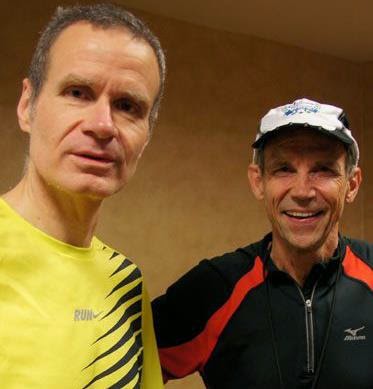
And I'm still running. On the way, I've bought Jeff Galloway's second edition book, another one of his book titled "Running Until You're 100," a run/walk/run timer from his website and actually met Jeff in 2012. (Thus this photo; he's the one on the right.)

I give him a lot of the credit that, despite a stroke, back problems and a knee injury, I ran today.

So I'm pleased to announce a new self-created widget for this blog - a series of training and motivation tips from Olympian Jeff. You can find it along the right side of this page. Every time the page loads, the widget generates a random tip from Jeff's list.

He's coached over a million runners - slow, fast and in between - to their goals through clinics, retreats, training programs, books and e-coaching. You can sign up for his free newsletter at www.JeffGalloway.com.

Now, what if you're not a runner? And I realize most people aren't. You can still benefit. Even if you walk - even slowly - you can use many of Jeff's tips from the new widget and from his books or website. I hope the new feature is helpful - as helpful I have always found his solid advice to be.

Thursday, February 05, 2015

Can you run too much for your health?

As you might know, I'm a longtime distance runner. And I'm convinced that was part of the reason I survived and recovered from my stroke in 1998.

When I began running back the late '80s, a 10-kilometer (6.2 miles) was a big race. A few decades later, half-marathon (13.1 miles) became in vogue. That still seems to be the case, although more and more I'm seeing races involving obstacle courses in addition to running.

Now that's a band wagon I'll never jump on.

Since some knee surgery last year, my running has been slower and less distances. This week, it was reported that might actually be better for me. So read this article titled Can a short jog lead to a longer life?:

Tuesday, February 03, 2015

'A light on my path'

Your word is a lamp for my feet, a light on my path.
Here in the Northern Hemisphere, we're living in the dark much of the time. On most days that I get out and run, it's before daylight. My particular path is at least in part on a local gravel trail - unlighted and not always smooth.

So to avoid stumbling and falling, I wear an LED headlamp on those days. It pierces the dark and helps me pick my way along the trail. It's a light on my path.

I watch, too, other runners and walkers find a lamp for their feet. I see them, often at quite a distance, guiding their steps with their lights.

Life, too, can be dark - no matter the time of day. Trying to follow God, I've found, gives light to my personal path. I don't - you don't - all of us don't - have to stumble in the dark. God's word is there to guide you.


Thursday, January 29, 2015

Home alone: Solitude might be dangerous for stroke patients

I can see lots of reasons that it might be true that, as one study finds, male stroke victims are at a greater risk of premature death when living alone:
Excess mortality was found among 36 percent of the patients living alone, as opposed to 17 percent of those with partners who died within 12 years after a stroke. The gap was also heavier among men at 44 percent to 14 percent.
"Among the conceivable causes are that people who live alone lead less healthy lives, are less prone to take their medication and tend to wait longer before going to the emergency room," Dr. Redfors said, in a news release. "For the healthy controls, excess mortality was also greater among men, particularly those living alone."
Now, does that mean single men need to find someone now? I'm not sure about that. But it would make sense to designate someone to act on your behalf if needed, in addition to the cautions the news release cites.


Tuesday, January 27, 2015

'May your love and faithfulness always protect me'

Do not withhold your mercy from me, Lord; may your love and faithfulness always protect me.
Ever at a loss for words? When trouble strikes? When someone is ill? What do you say? What do you pray for?

I struggle with this. Then, if I'm thinking clearly, I remember words like those from these verses, carrying a simple but powerful message. God loves you. God is faithful to you. God is here for your protection.

Does that mean Christians are to expect an easy life in this world with no challenges or suffering? No.

God's protection can be big-picture protection. When all earthly efforts fail, God is holding you in his protection. In love. Faithfully.

Today, let's pray that no matter what, recognize and feel God's love, faithfulness and protection.

Thursday, January 22, 2015

Young stroke survivor finds strength in determination

Photo from the U.S.
Centers for Disease
Control and Prevention
Are we all destined to run after a stroke? No. BUT, I still like stories like this because they do illustrate that after a stroke, determination is often key.

If you've visited this blog before, you'll know that was a runner before my stroke in 1998, started running again several weeks later, and continue to run. People, though, have different outcomes - physical, speech, vision, etc. - and not everyone can run. In fact, as the last post noted, stroke is the most common cause of permanent disability in the United States.

But the story is more than running. It's about a stroke survivor who found strength, a story that can echo in other lives. People might have different levels of abilities and strengths, different disabilities, different challenges. The important thing is to keep those challenges challenged.

So, here's a link, an excerpt and a video about a young stroke survivor finds strength in running:

Tuesday, January 20, 2015

As more stroke patients survive, more needs arise

Photo from the National
Library of Medicine
You've likely seen recent stories about how more people survive strokes. Generally, a good news story.

However, as this story illustrates, it also means that as more stroke patients live, more need rehab treatment:
More stroke patients now survive brain attacks that would have killed them a few years ago, and stroke has dropped from the fourth- to the fifth-leading cause of death in the U.S., the federal government said in late 2014.
With higher survival rates comes an increasing need for stroke rehabilitation programs for people like Cleveland, 41, who deal with varying disabilities.
In fact, stroke is one of the leading causes of disability.